The World Human Powered Speed Challenge provides an opportunity to break the land speed record for human powered vehicles without the aid of drafting, and without steep, downhill grades. The WHPSC has been held at Battle Mountain, Nevada, USA since 2000. The sanctioning body is the International Human Powered Vehicle Association. The Flying Start 200 meter Speed Trial is the primary event contested at the WHPSC. The WHPSC is open to all with qualifying each morning. Prior to the establishment of the WHPSC at Battle Mountain, to challenge the 200 meter event, racers would need to find a suitable venue, have the course surveyed, obtain permits to close the road as needed, obtain insurance, and have IHPVA officials with timing equipment witness the attempt. This was in addition to building a vehicle, and training a rider. Since the WHPSC was established, the administrative aspects are handled and racers can focus on developing the vehicle and rider. Racers are still free to hold record attempts at other locations.
IHPVA competition rules define various competition classes. Combinations of these classes constitute a record category. There are 160 record categories for each of the IHPVA’s 12 events. For the Flying Start 200 meter event, 37 of the 160 categories have records as of June 1, 2026. On this page you can find the full overview of Flying Start 200 m event categories and records.
The IHPVA competition classes are as follows.
- Single rider / Multiple rider
- Arms only
- Male / Female / Mixed
- Junior 11 years old and under
- Junior 12-14 years old
- Junior 15-17 years old
- Multitrack
- High altitude / Low altitude (above and below 700 m above sea level), (Battle Mountain course at 1407 meters above sea level is a high altitude course)
Todd Reichert riding the Aerovelo Eta at Battle Mountain holds the highest speed for the Flying Start 200 m event at 89.59 mph (144.17 kph) set in 2016 at Battle Mountain in the single rider, male, high altitude category. The complete list of IHPVA records is listed at the IHPVA website. IHPVA – International Human Powered Vehicle Association.
Course Description
The catch area of WHPSC race course is located on Nevada State Route 305,13.6 miles (21.9 km) south of Interstate 80. The race course runs from South to North using both lanes of the highway. There is a 4 km “qualifying course” and a 8 km “long course”. The shorter course starts half way along the long course. The road was repaved in 2009 with a very smoother surface specifically for the event. In recent years, however, the surface has grown progressively rougher hampering speed efforts. Figure 1 shows a map of the course relative to the city of Battle Mountain. Figure 2 is a diagram of the course showing the relevant landmarks. For safety, the Nevada Department of Transportation (NDOT) replaced the steel road markers with fiberglass markers. In the days leading up to the competition, volunteers distribute 120, 2-string straw bales along the course to protect wayward streamliners from falling into culverts, hitting occasional mailboxes or other hard obstacles. Volunteers also line the “bridge” (the lowest point of the course located a few hundred meters beyond the speedtrap) with overlapping 2 foot x 8 foot boards to prevent streamliners from sliding below the guardrail and hitting the posts.

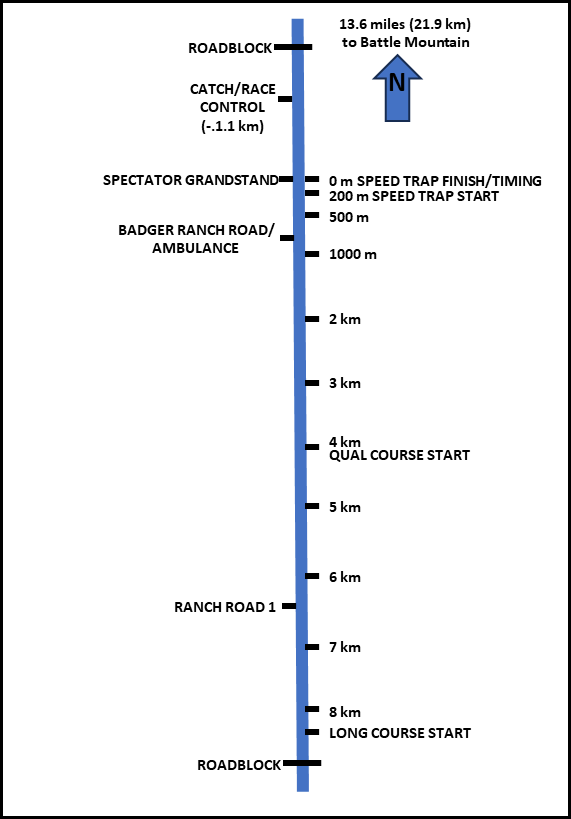
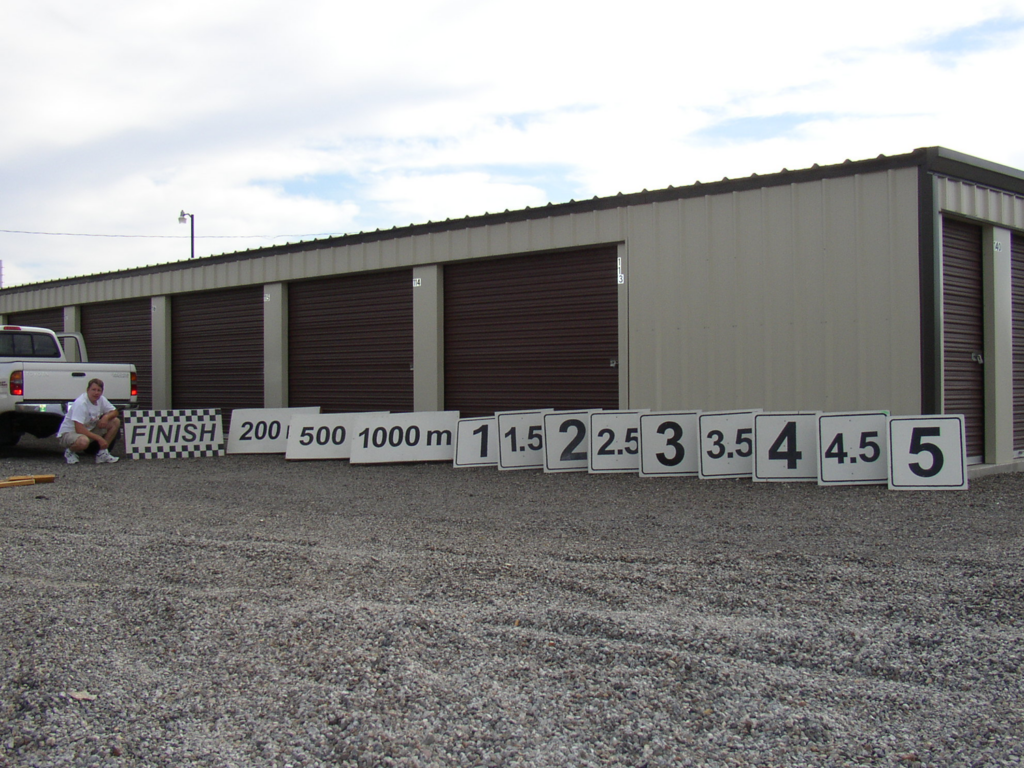
Volunteers set up race course distance markers on the right side of the road (in the direction of racing) that count down from 8 km every kilometer until 1 km to the finish before every race session. The 1 km distance is marked with a 1000 m sign. Beyond that are 500 m, 200 m, and FINISH signs. The timing trap begins at the 200 m sign and ends at the FINISH sign. The catch area is just over 1 km beyond the timing trap. Figure 3 shows early versions of the distance markers when the course was marked in half mile increments. Newer, larger signs are now used and the course is marked in kilometers.
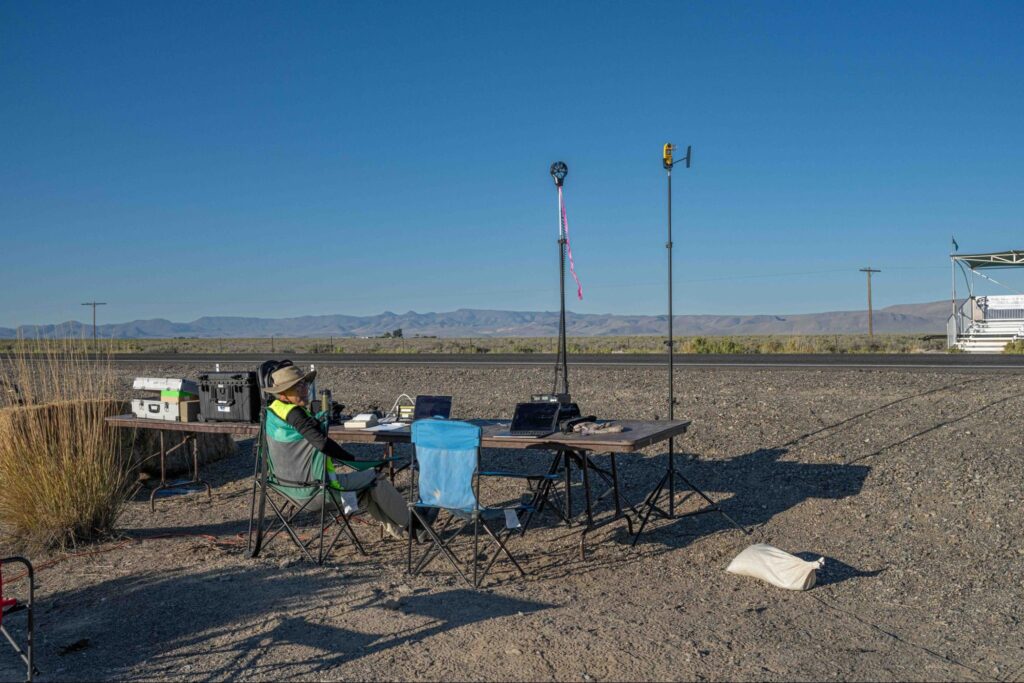
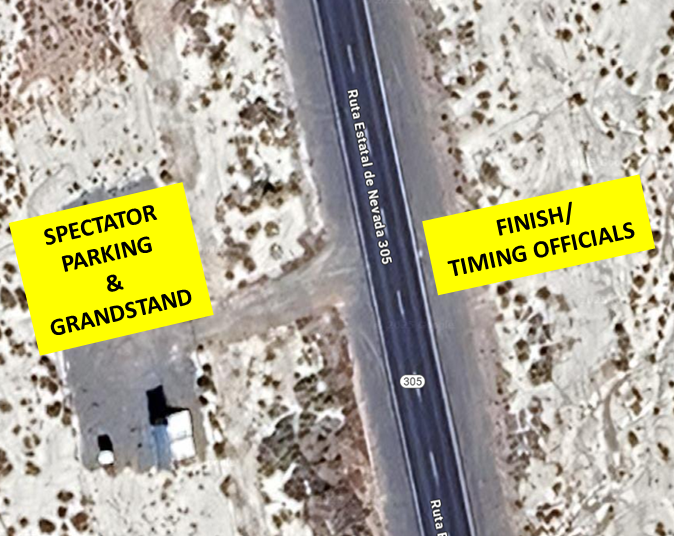
There are spectator grandstands and a parking lot across from the FINISH line. This is directly across the highway from the officials timing the runs. The officials display the 200 m elapsed time of each race vehicle as it exits the timing trap on an LED board facing the grandstand. Anyone wishing to watch from the spectator grandstand should park there while the road is open. After the road is closed, the grandstand can only be accessed on foot from the catch area by walking on the outside of the fence line. Figure 4 shows the timing area, figure 5 shows the spectator grandstand.

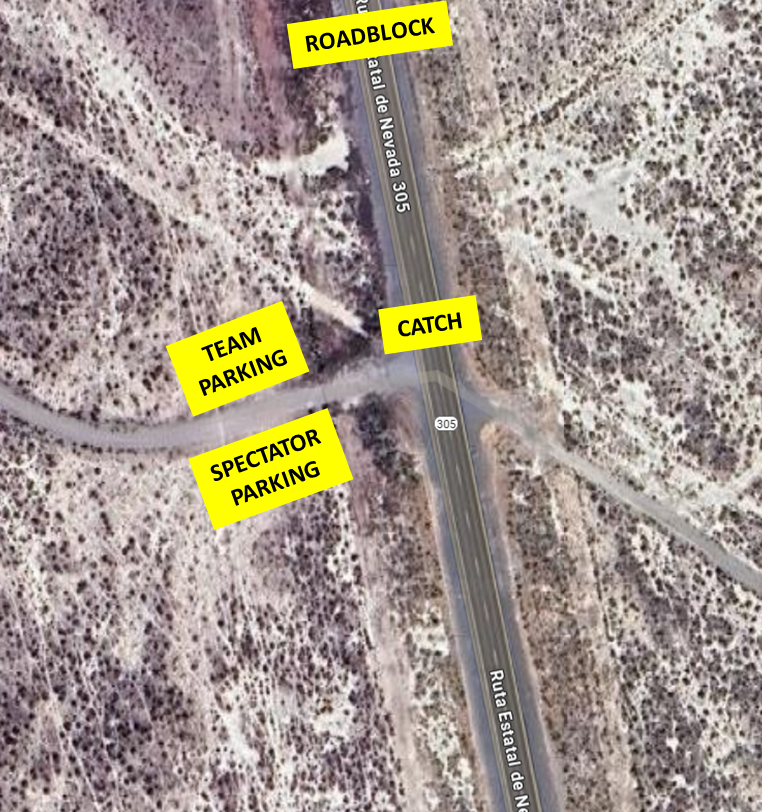
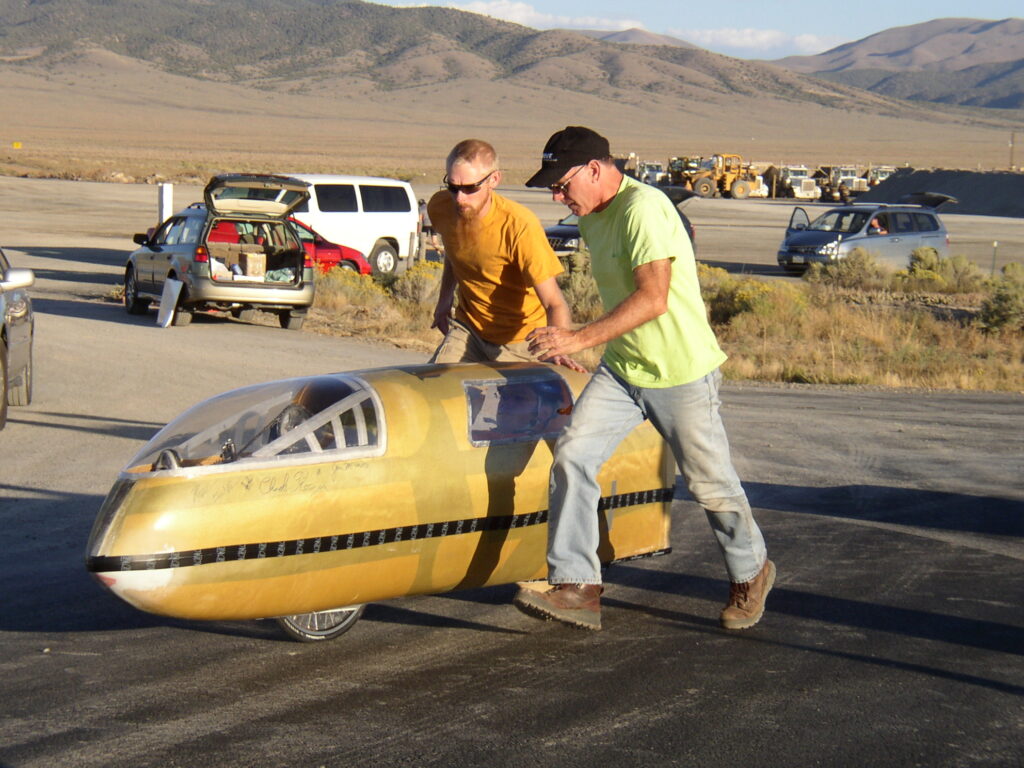
There are parking areas at the 8 km start, 4 km start, and the catch area. Motor vehicles are only allowed in the 4 km start area during short course runs. Vehicles are not allowed in the 4 km start area when 8 km runs are taking place. With the exception of the spectator area across from timing, vehicles are not allowed to park anywhere else along the course. This is for the safety of the racing vehicles. Once the road is closed for a race session, the last motor vehicle on the course is the sweep vehicle, checking to ensure the course is clear. Figures 6 through 9 show the parking areas for the catch area, spectator grandstand area, and short course and long course starting areas. Figure 10 shows a streamliner being launched on the long course.

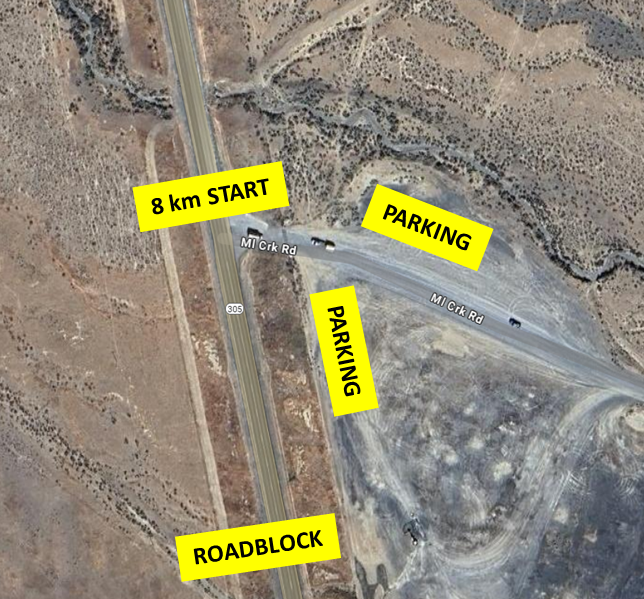
Two ranch roads intersect the course, Ranch Road 1 near the 7 km sign and Badger Ranch Road between the 1000 m and 500 m signs. Flaggers are stationed at these ranch roads and at roadblocks on each end of the course to ensure that no outside vehicles enter the course during a heat. An ambulance is stationed at Badger Ranch Road. Figures 11 and 12 show straw bales being dropped off for distribution in the 8 km start parking area and the bridge lined with protective boards.


Schedule
The event runs from September 12-19, 2026. Course preparation will precede the event from September 9-11, Wed-Fri. Technical inspections will be held on Saturday, Sep 12. Each vehicle and rider’s helmet must be inspected before qualifying. The technical inspection checklist is located here. Rules
Saturday evening at 7 pm, there will be a mandatory meeting at the Civic Center. Event organization and procedures will be reviewed, teams and officials will be introduced. Riders will select heats for Sunday morning qualifying. The more-detailed, hourly event schedule is located here. Documents – WHPSC
From Sunday, September 13 to Saturday, September 19, there will be morning and evening race sessions. There will be multiple heats in each session. Please review the Start Order Selection Process Documents – WHPSC for details on how racers select the heats in which they’ll race. All racing vehicles and riders must qualify on the 4 km course and achieve a minimum speed of 45 mph to be allowed to run on the 8 km course in the mornings. On Sunday morning, only the 4 km course is used as there will be many qualification heats. Mon-Wed morning sessions are held from 7:00-10:00 am beginning with heats on the 4 km course and then switching to the 8 km course. From Thu-Sat, it is intended that only the 8 km course is used in the morning. All evening sessions runs from 5:30-7:00 pm and only use the 8 km course. A minimum speed of 60 mph is required to run on the 8 km course in the evening. The 45 and 60 mph minimum speeds may be modified depending on the number of entries that achieve these speeds.
The “Qualifying run” (also known as “dynamic inspection”) is part of the technical inspection. The technical inspector and observers determine if the rider can control their bike at speed and has a safe means of stopping. Vehicles that experience mechanical failures or crashes during a run are required to undergo another tech inspection and re-qualify if deemed necessary.
The road is closed for each heat for a maximum of 20 minutes. This includes the time to clear motor vehicle traffic on the course. (The road is open to traffic between heats.) The sweep vehicle travels from the catch area to the start area. Once the sweep vehicle reaches the start area and the course is clear, racers are launched in 2 minute intervals. There are 4 to 5 heats in the morning session depending on how many racers use the qualifying course. There may be up to 5 racers per qualifying heat and 4 racers per long course heat. There are 3 heats in the evening with 4 racers per heat. Once called to the road, the first racer has 4 minutes to launch. The following racers are launched at approximately 2 minute intervals. If the first vehicle fails to launch, the second vehicle is launched at the 4 minute mark. The next vehicle must be ready to launch 2 minutes later.
There is a wrap-up meeting after each morning and evening session held at the Civic Center where the group will review how the session went and announce results. A team representative must be present as procedural issues may be discussed. In the morning post-race meeting, racers select heats for that evening’s session and the following morning session. There is no heat selection during the evening post-race meeting. Road closure times for the upcoming sessions along with the start order are established at these meetings. A team representative must be present to select a heat.
Event information is posted at the Civic Center. Please check daily for any changes to the schedule or procedures. Cancellations due to weather will be posted at the Civic Center.
There is a “Show & Shine” open house event at the Civic Center on Tuesday from 1-3 pm. The local 3rd grade students as well as the general public are invited. All teams display their vehicles and answer questions. Figure 13 shows an enthusiastic student seeing what it’s like to get in a streamliner.

On Saturday, the final day of racing, there will be a group photo shoot after the morning post-race meeting at the Civic Center. Figure 14 shows the vehicles and racers participating in the 2025 WHPSC.

On Saturday evening, after the final race session, there will be a banquet at the Civic Center at 8:30 pm which will serve as the post-race meeting and awards ceremony.
Rules
This event will be run under the IHPVA Competition Rules IHPVA – International Human Powered Vehicle Association and the WHPSC 2026 Technical Rules found in the rules section of the WHPSC.org website.
The start officials will be monitoring the distance with which teams assist their vehicle during launch. The maximum allowed distance is 15 meters. There will be small stripes on the road to assist with this measurement.
Each bicycle will be followed by a chase vehicle. Chasing a bike is a significant responsibility with regards to safety. Chase vehicle rules are located here Documents – WHPSC.
Protests
It is the responsibility of the race director to make the event run as smoothly and safely as possible. Any protest that cannot be resolved by the directors will be decided by a committee of all riders qualified to run on 305. Decisions will be by simple majority. The race director or their designate will chair the meeting and have the authority to break any tie vote.
Any protest / disagreement concerning the day’s events or the announced starting order shall be voiced at the next wrap-up meeting. If a problem arises that needs to be addressed after the wrap-up meeting but before the next racing session, the protestant shall be responsible for notifying the race director and all qualified riders to attend a special rider’s meeting to hear the complaint.
Miscellaneous
- Each Team must complete an entry form, IHPVA membership forms, ABR membership forms for riders, IHPVA-WHPSC waivers, and pay all fees before their first time on the road. The entry form is located at the WHPSC website. (2026 form to be made available soon)
- Teams are responsible for having chase vehicle personnel (minimum two + driver) and for ensuring the chase vehicle personnel know the rules and procedures. This will be checked at the start of every heat.
- Teams are responsible for having people designated as their start crew, and making sure they know how to launch the vehicle.
- Teams are responsible for informing the catch crew of any special procedures required for their vehicle and providing special tools as required. The catch team will put any tape removed from your bike onto the seat in the bottom tub, don’t forget to remove it before your next run.
- All personnel must wear orange or yellow safety vests, shirts, or jackets when on or within 30 feet (10 meters) of SR 305. The only exception is riders racing within the active heat.
- Teams are to post contact information on the Contact Sign Up Sheet at the Civic Center. Teams may be contacted if there are schedule changes or cancellation of a session due to weather conditions.
Volunteers
Course officials, timing officials, start officials, and volunteers must be IHPVA members for liability insurance purposes.
List of officials
- Race Director (2), normally stationed at Catch
- Coordinate road closures, catch area, sweep area, ambulance
- Timing Officials (3): Head timer, assistant, 200 m assistant
- Time vehicles though speed trap, record wind speed
- Spectator Grandstand Announcer (1)
- Provide info on teams, vehicles, riders, and who is on course
- Start Officials (2): Head starter, assistant
- Coordinate teams, control bikes on the road, launch bikes, observe adherence to 15 m launch rule
- Flaggers (5): Start, Finish, Ranch Road 1, Badger Ranch Road
- Flaggers at start and finish control motor vehicle traffic. Flaggers at ranch roads control local mid-course traffic
- Ambulance Personnel
- Chase Vehicle Officials (5), one per chase vehicle
- Observe and communicate status of bikes along the course to other chase vehicles and race director. Communication radios will be provided by the IHPVA.
- Sweep Vehicle Official (1)
- Last vehicle to check course for safety issues prior to start of race session
Insurance
(adjusted 14 July 2026)
Anyone on the racing surface during event road closures must be an IHPVA member to comply with insurance requirements. This includes but is not limited to riders, builders/owners, team advisors/managers, team members, officials, chase vehicle members, and volunteers. These persons are “WHPSC participants.” The IHPVA membership form is available at the WHPSC website. Bring signed hardcopy to the event (preferred), or complete hardcopy at the event.
Liability insurance – The club (IHPVA) is a member of American Bicycle Racing (ABR). The event (WHPSC) is registered with ABR. The club and event are covered by ABR liability insurance for claims by others, such as spectators, ranchers, motorists at roadblocks. Upon request, the policy can be emailed to you.
Accident insurance – As noted above, anyone on the racing surface must be an IHPVA member to comply with insurance requirements. These IHPVA members are covered for accidents via ABR insurance. The ABR insurance is available at the Documents section of the website. There are 2 documents: the Participating Organization Application (2 pages), and the Certificate of Coverage (14 pages).
All WHPSC participants must sign the form titled “Informed Consent, Assumption of Risk, Waiver and Release of Liability and Entry.” The form is available at the Documents section of the website and as hard copies at the event.
All forms must be completed before your team will be allowed to race.
New since 2025:
- Riders do not need to join ABR as an individual member.
- All WHPSC Participants are covered by the accident insurance policy.
Speed Hats
Embroidered, baseball cap-style hats for riders setting personal records of at least 50 mph are presented at the Saturday night awards banquet. Hats are awarded in 5 mph increments up to 90 mph (so far). If several speed hat thresholds are exceeded by a rider during race week, only the highest speed record will be honored. Figure 15 shows various speed hats. The complete list of hats that have been awarded is shown here. Note, the speeds for which hats have been awarded is shown in the table. A rider may have exceeded this speed in subsequent years but did not break the next 5 mph threshold. For example, Francois Pervis is shown to have earned an 85 mph hat by achieving 86.92 mph in 2023. In 2025, Francois set a personal record at 88.07 mph. Francois’s row in the table will not be revised or replaced until he breaks 90 mph (or higher). This is not an “all-time performance” speed table, it is a table showing the award of the speed hats.

While wind speed must be below 6 kph for world record purposes, the wind rule is disregarded for speed hats. This is new for 2026. Hats will not be awarded retroactively for previous years’ performances.